
In today’s digital world, businesses rely heavily on computers, smartphones, tablets, servers, and other connected devices. While these devices make work faster and more convenient, they also create opportunities for cybercriminals. Every device connected to a company’s network can potentially become a doorway for malware, ransomware, data theft, or unauthorized access.
This is where Endpoint Security becomes important. Endpoint security is a cybersecurity approach designed to protect devices that connect to a business network. These devices, commonly called endpoints, may include laptops, desktop computers, mobile phones, tablets, servers, and other internet-connected systems.
As cyber threats continue to become more sophisticated, organizations of all sizes need effective endpoint protection. A single compromised device can sometimes give attackers access to sensitive business information, customer data, applications, and entire networks.
What Is Endpoint Security?
Endpoint security refers to the technologies, policies, and security practices used to protect endpoint devices from cyber threats. Its main purpose is to prevent unauthorized access, detect suspicious activity, block malware, and reduce the risk of data breaches.
Traditional antivirus software was mainly designed to identify and remove known viruses. Modern endpoint security goes much further. It can use behavioral monitoring, threat intelligence, artificial intelligence, machine learning, encryption, access controls, and centralized management to protect devices against a wider range of threats.
For example, if an employee accidentally downloads a malicious file, an endpoint security solution may detect unusual behavior and block the file before it can damage the system.
Why Is Endpoint Security Important?
The number of connected devices used by organizations has increased significantly. Employees may work from offices, homes, coffee shops, airports, or other locations. Remote and hybrid work have also made it more difficult for organizations to maintain traditional network boundaries.
Every connected device represents a possible attack surface.
Cybercriminals can target endpoints through phishing emails, malicious downloads, fake software updates, infected websites, stolen passwords, removable storage devices, and other techniques.
Effective endpoint security helps organizations:
- Prevent malware and ransomware infections
- Detect suspicious activities
- Protect sensitive business information
- Control access to company systems
- Reduce the risk of data breaches
- Monitor devices across the organization
- Respond quickly to security incidents
- Maintain compliance with security requirements
Without proper endpoint protection, even a small organization can become a target for cybercriminals.
Common Endpoint Security Threats
There are many threats that can affect endpoint devices. Understanding these risks is an important part of building an effective cybersecurity strategy.
Malware is one of the most common threats. It includes malicious software such as viruses, worms, trojans, spyware, and other programs designed to harm systems or steal information.
Ransomware is another serious threat. It can encrypt files on an infected device and demand payment from the victim. In business environments, ransomware can disrupt operations and cause significant financial losses.
Phishing attacks can also compromise endpoints. Attackers may send emails that appear to come from trusted organizations or employees. A user who clicks a malicious link or opens an infected attachment may unintentionally install malware or provide login credentials.
Unauthorized applications can create additional risks. Employees sometimes install software without checking whether it is safe. Some applications may contain vulnerabilities or malicious components.
Stolen or weak credentials can also allow attackers to access protected systems. For this reason, endpoint security often works alongside strong authentication and access-control measures.
How Does Endpoint Security Work?
Endpoint security solutions generally use multiple layers of protection rather than relying on a single security feature.
First, the system may scan files, applications, and processes for known threats. If suspicious software is detected, it can block or quarantine the threat.
Modern solutions can also analyze behavior. Instead of looking only for known malware signatures, they can identify unusual activities. For instance, if an application suddenly attempts to modify hundreds of files, access sensitive information, or communicate with an unfamiliar server, the security system may flag the behavior.
Endpoint security platforms can also provide centralized visibility. Security teams can monitor devices from a central dashboard and investigate alerts across the organization.
Some advanced solutions provide endpoint detection and response capabilities. These technologies help security teams investigate suspicious incidents, identify what happened, and take action to contain threats.
Endpoint Security vs. Antivirus
Endpoint security and antivirus software are related, but they are not exactly the same.
Traditional antivirus software focuses mainly on detecting and removing malicious software. It remains useful, but modern cyber threats often require more advanced protection.
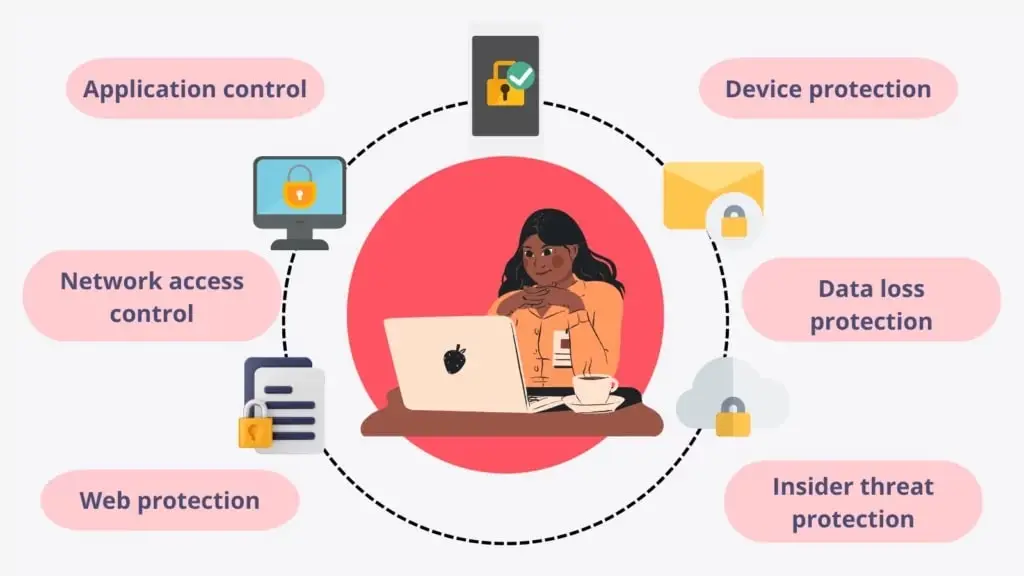
Endpoint security can include antivirus capabilities while also providing additional features such as:
- Behavioral threat detection
- Device monitoring
- Application control
- Web protection
- Data protection
- Endpoint visibility
- Automated threat response
- Centralized security management
In simple terms, antivirus can be considered one component of a broader endpoint security strategy.
Key Features of Endpoint Security Solutions
Different endpoint security products offer different capabilities, but several features are commonly important.
Real-time protection continuously monitors devices and can block threats as they appear.
Threat detection helps identify malicious files, suspicious applications, unusual behavior, and potential attacks.
Centralized management allows security teams to manage protection across multiple devices from one location.
Application control can prevent unauthorized or potentially dangerous applications from running.
Web protection helps block malicious websites, dangerous downloads, and suspicious online content.
Device control can restrict the use of removable devices such as USB drives when necessary.
Data protection can help prevent sensitive information from being accessed or transferred improperly.
Incident response capabilities help organizations investigate and contain security incidents quickly.
Benefits of Endpoint Security for Businesses
One of the biggest benefits of endpoint security is improved protection against cyberattacks. By monitoring devices continuously, organizations can identify threats before they become larger incidents.
Another major advantage is centralized visibility. Instead of manually checking every computer, security teams can use a centralized platform to monitor devices and receive alerts.
Endpoint security can also improve productivity. A successful cyberattack can cause downtime, disrupt operations, and force employees to stop working. Preventing these incidents helps businesses maintain normal operations.
Data protection is another important benefit. Businesses often store customer information, financial records, intellectual property, and confidential communications on endpoint devices. Protecting those devices helps reduce the risk of sensitive data being exposed.
Endpoint security can also support regulatory compliance. Depending on the industry and location, organizations may have specific requirements for protecting customer or employee information.
Best Practices for Endpoint Security
Technology alone cannot provide complete protection. Businesses should combine endpoint security solutions with good cybersecurity practices.
First, organizations should keep operating systems and applications updated. Software updates frequently include security patches that address known vulnerabilities.
Strong passwords and multi-factor authentication should also be used wherever possible. Even if a password is stolen, additional authentication can make unauthorized access more difficult.
Employees should receive regular cybersecurity awareness training. They should understand how to recognize suspicious emails, links, attachments, and websites.
Organizations should also maintain regular backups of important data. Backups can be extremely valuable during ransomware attacks or other incidents.
Access should be limited according to business requirements. Employees should only have the permissions necessary to perform their jobs.
Finally, security teams should regularly review alerts, update security policies, and test their incident-response procedures.
The Future of Endpoint Security
Cybersecurity threats are constantly changing, so endpoint security will continue to evolve. Artificial intelligence and machine learning are increasingly being used to analyze large amounts of security data and identify unusual behavior.
Cloud-based security platforms are also becoming more common because they can make it easier to protect distributed workforces and devices located in different environments.
The growing use of mobile devices, Internet of Things devices, remote work systems, and cloud applications means that organizations will need broader visibility across their digital environments.
Future endpoint security solutions are likely to focus even more on automated detection, faster response, identity protection, and integration with other cybersecurity technologies.
Frequently Asked Questions (FAQs)
1. What is Endpoint Security?
Endpoint security is a cybersecurity approach that protects devices connected to a business network. It can protect laptops, desktops, smartphones, tablets, servers, and other endpoints against malware, unauthorized access, data theft, and other cyber threats.
2. Why is Endpoint Security important?
Endpoint security is important because every connected device can potentially become a target for cybercriminals. Protecting endpoints helps businesses reduce the risk of malware, ransomware, data breaches, and unauthorized access.
3. Is Endpoint Security the same as antivirus?
No. Antivirus is generally focused on detecting and removing malicious software, while endpoint security provides broader protection. It may include antivirus along with behavioral monitoring, application control, web protection, device management, and incident response capabilities.
4. What devices can Endpoint Security protect?
Endpoint security can protect many types of connected devices, including desktop computers, laptops, smartphones, tablets, servers, and other organizational endpoints. The exact devices supported depend on the security solution being used.
5. Can Endpoint Security prevent ransomware?
Endpoint security can help prevent and detect ransomware by identifying malicious files, suspicious behavior, and unauthorized activities. However, no single security technology can guarantee complete protection, so businesses should also use backups, employee training, access controls, and other security measures.
6. Does Endpoint Security protect remote workers?
Yes. Modern endpoint security solutions can protect devices used by remote employees. This is particularly important because remote workers may connect from home networks, public Wi-Fi, and other environments outside the traditional corporate network.
7. How can businesses improve Endpoint Security?
Businesses can improve endpoint security by keeping software updated, using strong passwords and multi-factor authentication, training employees, restricting unnecessary access, maintaining backups, monitoring devices, and using reliable endpoint protection technology.
8. What is the difference between Endpoint Security and Network Security?
Endpoint security focuses primarily on protecting individual devices, while network security focuses on protecting the organization’s network and the traffic moving through it. Both are important and are often used together as part of a broader cybersecurity strategy.
Conclusion
Endpoint security is an essential part of modern cybersecurity. As businesses become increasingly dependent on connected devices, protecting those devices becomes just as important as protecting the network itself.
A strong endpoint security strategy can help organizations detect threats, prevent malware infections, protect sensitive data, and respond to suspicious activity. However, effective security requires more than simply installing software. Regular updates, strong authentication, employee training, data backups, access controls, and continuous monitoring should all work together.
Whether a business has a few devices or thousands of endpoints, investing in appropriate endpoint security can significantly reduce cybersecurity risks and help create a safer digital environment.